

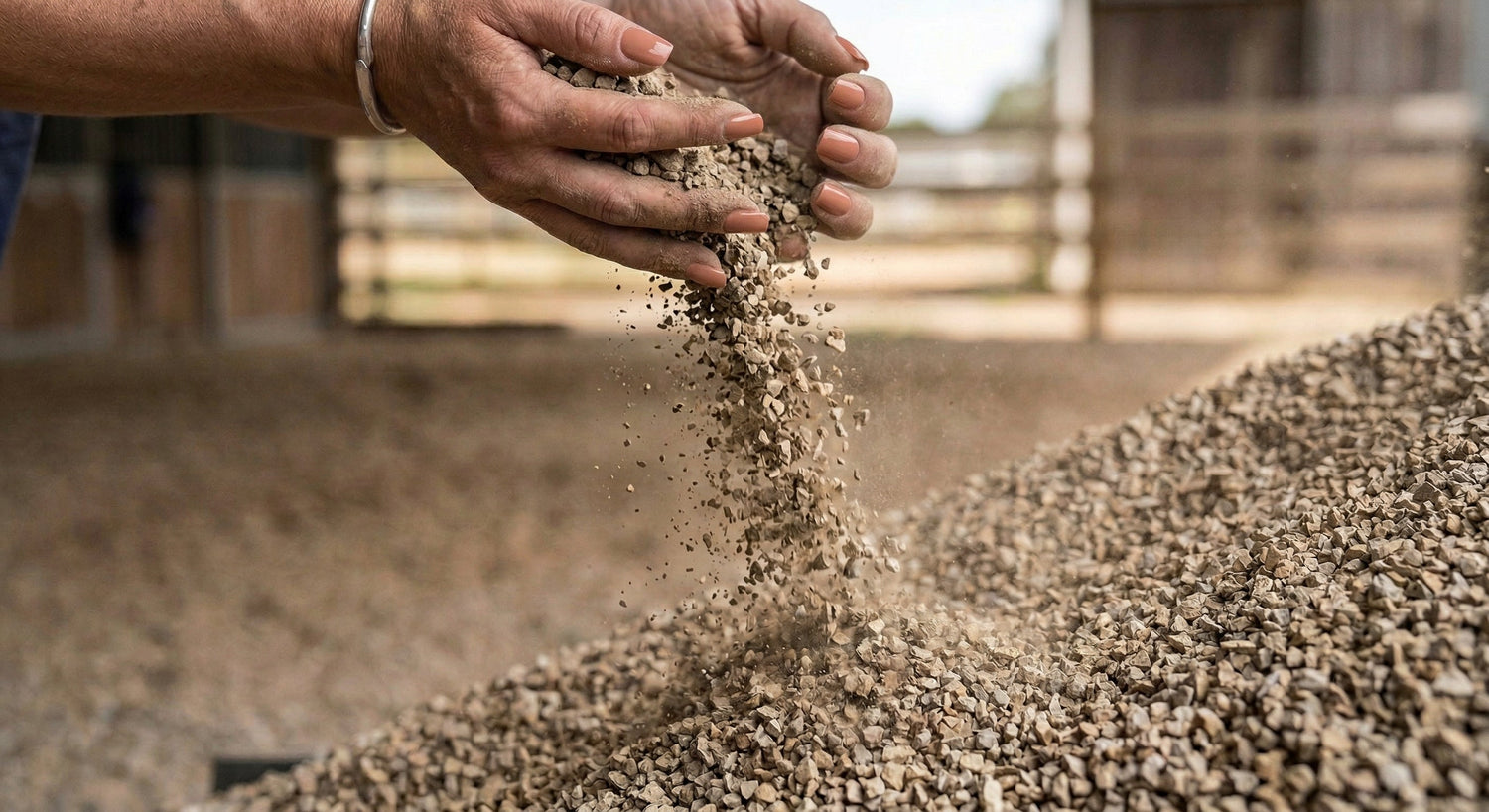
Gravel is the single most common question we get from customers — and from horse owners in general. What kind do I need? What's it called at my quarry? Can I use pea gravel? How much do I order? Will it hurt their feet?
The frustrating part is that gravel naming conventions vary wildly by region. The same product might be called "crusher fines" in Washington, "quarter-inch minus" in Texas, "decomposed granite" in Arizona, and "#78M" in Virginia. The quarry down the road from you may use a completely different term than the quarry 30 miles away.
The good news: choosing the right gravel for a horse paddock is actually simple once you know what to look for. Forget the names. Focus on three physical characteristics, and you'll get the right product every time — regardless of what your local quarry calls it.
The Three Rules of Paddock Gravel
Every gravel decision comes down to three things: shape, size, and mix. Get all three right and you'll have a supportive, hoof-friendly surface that lasts. Get any one of them wrong and you'll be dealing with shifting footing, mud, or bruised hooves.
Rule 1: Angular, Not Round
This is the most important rule.
Angular gravel is crushed at a quarry — larger rocks are mechanically broken into smaller pieces, creating fragments with sharp, irregular edges. When these angular pieces are pressed together, the edges interlock and lock into place, creating a stable surface that resists movement under hoof traffic.
Round gravel — like pea gravel, river rock, or drain rock — was shaped naturally by water. The smooth surfaces have nothing to grab onto. Under pressure, round stones roll against each other like marbles. They shift, migrate, and create an unstable surface that never truly compacts.
The difference is mechanical: angular pieces wedge together and stay put. Round pieces slide past each other and don't.
When you're at the quarry or on their website, look for words like "crushed," "angular," or "aggregate." Avoid anything described as "river," "tumbled," "drain," "smooth," or "washed."
Rule 2: Varied Particle Size — You Need the Fines
The right gravel isn't all the same size. It's a mix of particles ranging from the largest pieces down to very fine material — sand-sized particles and dust. In the industry, this fine material is called "fines."
Fines are what make gravel work as a surface material. When you compact a gravel mix, the larger pieces form the structure and the fines fill in all the gaps between them. This locks everything together into a dense, firm surface — almost like a natural cement (but with better give and traction than actual cement).
Without fines, you have gaps between every stone. Water pools in those gaps. Hooves push the stones apart. The surface never firms up.
This is why "clean" or "washed" stone doesn't work for paddock footing. The washing process removes the fines on purpose — which is great for drainage pipe backfill but terrible for a surface you need to compact firmly.
The word to look for is "minus." When a gravel product is described as "3/8 inch minus" or "1/4 inch minus," the "minus" means it contains everything from the stated maximum size all the way down to dust. That's exactly what you want.
Rule 3: Maximum Particle Size of 1/2 Inch — Ideally 3/8 or 1/4 Inch
The smaller the largest particle, the smoother and more hoof-friendly the compacted surface will be.
Our ideal recommendation is 3/8" minus or 1/4" minus angular crushed rock. At this size, the compacted surface is very flat and even. Horses can stand, walk, lie down, and roll on it comfortably.
Larger stone — particularly anything approaching 3/4" or 1" — can work its way to the surface over time, especially under hoof traffic. Large pieces sitting proud of the surface can cause stone bruising on the sole of the hoof. They're also harder to compact evenly and more difficult to muck off of.
If your quarry only carries 3/4" minus, it can technically work — but it requires more effort to compact properly and you may need to monitor for larger pieces surfacing. We generally find that 3/8" minus or 1/4" minus is worth seeking out.
What to Ask For at the Quarry
Here's what to say when you call:
"I'm looking for 3/8 inch minus or quarter-inch minus angular crushed rock. I need the fines left in — not washed or clean. It's for a horse paddock, so I need it to compact into a firm, flat surface."
That's it. Most quarry employees will know exactly what you mean.
Common Product Names by Region
Because the same product goes by different names in different areas, here are terms that generally (but not always) describe the right type of gravel. Always verify particle size, angularity, and the presence of fines before buying.
Terms that usually indicate the right product:
- 3/8" minus or 1/4" minus — The clearest description. "Minus" means varied particle size down to dust.
- Crusher fines — Very fine crushed material, often angular and well-graded. Common in the Pacific Northwest and Mountain West.
- Decomposed granite (DG) — Common in the Southwest. Usually angular and well-graded. Verify that it's a crushed product, not a naturally weathered one.
- Stone dust or screenings — The very finest fraction from the crushing process. Can be used alone or blended with slightly coarser material. On its own, it compacts well but may be dusty in dry conditions and can develop a soft, porridge-like consistency on the surface during heavy rains.
- Paver base — Often the right size and composition, as it's designed to compact under hardscape pavers. Check that the maximum particle size isn't too large (some paver bases contain 3/4" stone).
- Aggregate base or road base — Similar to paver base. Usually well-graded with fines. Check maximum particle size — some road base products contain stone up to 1" or larger.
- #78M with fines — A numbered aggregate specification that falls in the right size range (common in the Mid-Atlantic and Southeast).
Pro tip: If the large construction quarries in your area don't carry the right product, try a local landscape supply company. They often stock finer crushed products designed for setting hardscape pavers and outdoor living projects — and it's usually the same material you need. You can also search Google for "sand and gravel" in your area to find smaller suppliers that may carry exactly what you're looking for.
What NOT to Use
These are the products that horse owners most commonly buy by mistake. Each one fails for a specific, predictable reason.
Pea Gravel
Pea gravel is round, smooth, and uniform in size — the opposite of everything you need. It will not compact. It rolls under hoof pressure, creating an unstable surface that shifts and migrates constantly. Horses' feet sink into it at odd angles, putting stress on tendons. In a thin layer over hard ground, it can be dangerously slippery. It does not work inside geocell panels or as high traffic paddock footing. It can be a nice surface for barefoot horses in medium traffic areas and is commonly used around the base of trees or other lower traffic areas.
Sand
Sand does not compact into a stable surface. It shifts under hoof traffic, migrates with water, and doesn't usually compact well. While sand has some uses in equine settings (arena footing, rolling areas), it is not suitable for use within Lighthoof panels or as a paddock base. We recommend using sand strategically in certain areas on top of the gravel-filled and compacted Lighthoof panels to create a comfy rolling spot.
Clean or Washed Stone
"Clean" stone has had all the fines washed out of it. It's designed for drainage applications where you want water to flow freely through gaps between the stones. Without fines, there's nothing to fill the gaps and lock the pieces together. The surface never firms up and behaves more like loose gravel than a compacted pad.
Crusher Run (3/4" or 1" Minus)
This one is tricky because crusher run contains fines and is angular — so it meets two of the three rules. The problem is the maximum particle size. At 3/4" to 1", the largest stones are big enough to bruise the sole of a horse's hoof. They're also harder to compact into an even surface, and larger pieces tend to work their way up over time. If 3/8" minus isn't available, crusher run is better than nothing — but it's not ideal.
Screenings Alone
Pure screenings (the finest fraction from the crushing process, with no larger particles) compact well and can work in a pinch. However, some customers find them overly dusty in dry weather and report a soft, porridge-like surface layer during heavy rains. Screenings work better as part of a blend than as a standalone product. However, they are commonly used within Lighthoof panels and do seem to compact well.
My Quarry Doesn't Have It — What Do I Do?
This happens. Not every quarry carries the ideal product. Here are your options:
Option 1: Ask Them to Make It
Many quarries can custom-blend products or screen material to a specific size if you ask. Provide them with this guide or explain that you need a fine mix of angular crushed rock for horse paddock footing. They deal with custom requests regularly.
Option 2: Blend It Yourself
If your quarry carries 3/8" clean crushed stone (angular but without fines) and also sells screenings, stone dust, or crusher fines separately, you can blend them yourself. A 60/40 or 70/30 ratio (more stone, less fines) works well.
Important: Mix the materials together before placing them in your paddock or panels. Do not layer them (fines on top of clean stone or vice versa). Layered materials will not readily combine and you won't get the interlocking effect you need.
Option 3: Try a Different Supplier
Landscape supply companies, hardscape suppliers, and smaller sand-and-gravel operations sometimes carry products that the big construction quarries don't. Search for "sand and gravel" or "landscape supply" in your area and call around.
Option 4: Send Us Your Quarry's Product List
If you're not sure whether a product will work, send us a link to your quarry's website or product list at mud@lighthoof.com or call us at 800-279-4716. We review quarry offerings for customers every day and can tell you exactly which product to order. If you're looking at a product in person, take a photo with a coin next to the gravel for size reference and send it to us.
Does Gravel Hurt Their Hooves?
This is one of the most common concerns we hear, and it's understandable — nobody wants to put their horse on a surface that causes discomfort.
The answer is that 3/8" minus crushed rock, once compacted, creates a very flat and firm surface. It's not like walking on loose rock. The varied particle sizes fill in all the gaps, and after compaction, the surface is smooth and even. Horses stand, walk, lie down, and roll on it without issue.
If your horses are barefoot and have been living on soft ground, there may be a brief adjustment period as their hooves toughen up — similar to the transition any barefoot horse goes through when moving to firmer footing. This is normal and typically resolves quickly.
We do recommend daily hoof picking regardless of footing type. Small gravel particles can occasionally lodge in the white line area of the hoof, and regular cleaning prevents any issues from developing.
How Much Gravel Do I Need?
For a standard Lighthoof installation — which fills the 3-inch cells and adds approximately 1-2 inches of loose gravel on top of the panels — plan on 1.75 cubic yards per panel.
Each Lighthoof panel covers 72 square feet (6' x 12'). Here's a quick reference:
| Project Size | Panels | Gravel Needed | Approximate Coverage |
|---|---|---|---|
| Gate area | 2–4 | 3.5–7 yards | 144–288 sq ft |
| Single stall run (12' x 60') | 5 | 10 yards | 360 sq ft |
| Small paddock | 10 | 17.5–20 yards | 720 sq ft |
| Medium paddock (24' x 36') | 12 | 21–24 yards | 864 sq ft |
| Large dry lot (36' x 48') | 24 | 42–48 yards | 1,728 sq ft |
For smaller projects (10 panels or fewer), we recommend ordering 2 yards per panel rather than 1.75. The extra material gives you a reserve for top-dressing and maintenance in the coming seasons without scheduling another gravel delivery. Gravel settles and compacts after installation, and having a small stockpile on hand for touch-ups is far more convenient than ordering a second delivery for half a yard.
A Note on Delivery
Before you order, confirm that the delivery truck can access your installation site. Standard gravel trucks need a firm, relatively flat surface and enough room to dump or spread. If access is tight, ask the quarry what truck sizes they offer — some suppliers have smaller trucks available for residential deliveries.
How Much Does Gravel Cost?
Gravel pricing is highly variable depending on your geographic location, distance from the quarry, and current fuel prices.
As a general range:
- Low end: ~$18/yard delivered (areas close to quarries with competitive markets)
- Average: $25–$45/yard delivered
- High end: Can exceed $45/yard in remote areas or during periods of high fuel costs
Delivery charges are often the biggest variable. The stone itself is relatively inexpensive — it's the trucking that adds up, especially if your nearest quarry is more than 20–30 miles away.
Tips for getting the best price:
- Call 2–3 quarries and landscape supply companies for quotes. Prices can vary significantly between suppliers in the same area.
- Ask about delivery minimums. Many quarries require a minimum order (often 5–10 yards) for delivery.
- If you're ordering a larger quantity, ask whether pricing improves at higher volumes.
- Search Google for "sand and gravel" in your region — smaller operations sometimes offer better pricing than large commercial quarries.
Quick-Reference Cheat Sheet
Save this or screenshot it for when you're ready to order.
| Material | Works for Horse Paddock Footing? | Notes |
|---|---|---|
| 3/8" minus crushed rock | Yes — Ideal | Angular, well-graded, compacts into a firm surface |
| 1/4" minus crushed rock | Yes — Ideal | Finer version of above, very smooth when compacted |
| Crusher fines | Yes | Common in PNW/Mountain West, usually well-graded |
| Decomposed granite (DG) | Yes | Verify it's a crushed product with fines |
| 60/40 or 70/30 blend (clean crushed + fines) | Yes | Mix before placing — do not layer |
| Screenings / stone dust alone | Okay | Compacts well but can be dusty dry / soft when very wet |
| 3/4" minus (crusher run) | Okay | Larger stones may bruise hooves; harder to compact evenly |
| Pea gravel | No | Round, won't compact, shifts and migrates |
| Sand | No | Won't compact, migrates, unstable surface |
| Clean / washed stone | No | Missing fines — won't lock together |
| River rock / drain rock | No | Round, large, designed for drainage not footing |
One Less Thing to Worry About
Choosing the right gravel is one of those decisions that feels overwhelming until you understand the three rules: angular, with fines, and no larger than 1/2 inch. Once you know what to look for, it's a quick phone call to your local quarry.
If you're using Lighthoof panels, the gravel decision matters even more — because the cells hold the gravel in place permanently, you want the right material locked in from the start. The upside is that you only need 3–4 inches of it, compared to the 8+ inches required for an unstabilized gravel pad.
For a printable version of this guide, download our Lighthoof Gravel Guide PDF.
And if you're staring at your quarry's product list and not sure what to pick — send it to us at mud@lighthoof.com or call 800-279-4716. We do this every day and we're happy to help you choose.


Leave a comment
This site is protected by hCaptcha and the hCaptcha Privacy Policy and Terms of Service apply.